
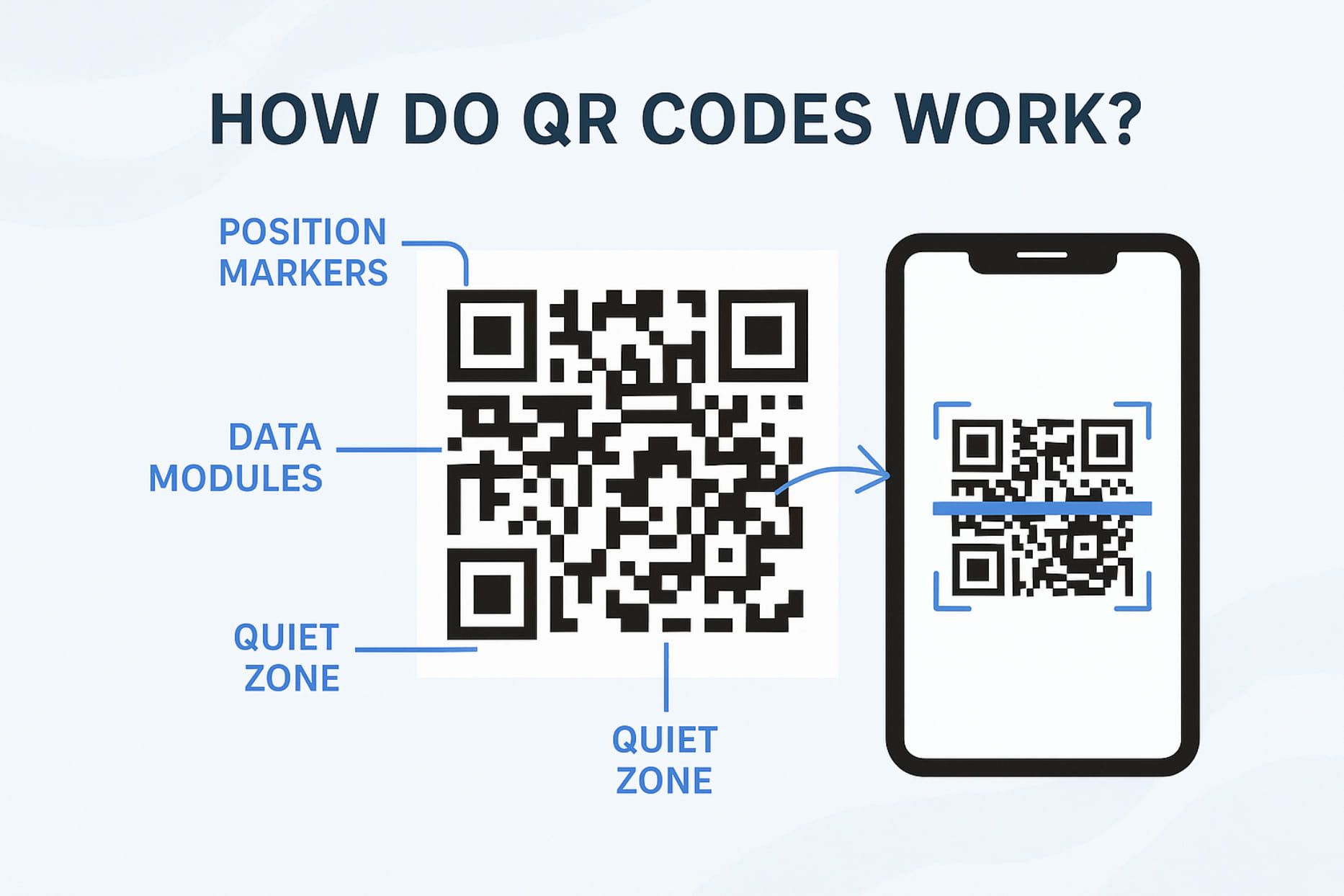
QR codes may look like simple black and white squares, but they rely on advanced data encoding, error correction, and scanning logic to work reliably. Each QR code stores information in a structured grid that can be decoded quickly from any angle. This guide explains how QR codes work at a technical level, how scanners read them, and why they remain reliable even in real world conditions.
What Is a QR Code Technically
From a technical perspective, a QR code is a two dimensional data matrix designed to encode information in a machine readable format. Instead of storing data in a single line like traditional barcodes, QR codes distribute data across rows and columns within a square grid.
Each QR code consists of multiple functional regions, including position markers, timing patterns, alignment patterns, and data modules. These elements work together to help scanning devices detect, orient, and decode the information accurately.
The technical design allows QR codes to be scanned quickly and reliably, which is why they are widely supported across devices and platforms today. For a non technical overview, refer to What Is a QR Code The Complete Beginners Guide.
Why QR Codes Use Black and White Squares
QR codes use black and white squares because scanners rely on contrast to distinguish data. Black squares represent binary data values, while white squares represent the absence of data. This clear contrast allows scanners to identify patterns quickly.
The square shape ensures consistent spacing and alignment across the entire code. This uniform structure makes it easier for scanners to calculate positioning and orientation without requiring precise alignment by the user.
Using only black and white also improves reliability across different lighting conditions and printing surfaces. This design choice plays a major role in why QR codes can be scanned accurately even when printed small or displayed on screens.
How Data Is Stored Inside a QR Code
Data inside a QR code is stored as a sequence of binary values that are converted into visual patterns. The information is first encoded into a standardized format, then placed into the data modules of the QR code grid.
Before final placement, the data is processed using encoding modes such as numeric, alphanumeric, or binary. These modes determine how efficiently the information is stored.
Once encoded, the data is distributed across the grid in a predefined pattern. This structured placement ensures that the information can be reconstructed even if part of the code is damaged. Different QR Code Types rely on this same foundational storage method.
Error Correction in QR Codes Explained
Error correction is one of the most important technical features of QR codes. It allows a QR code to be scanned successfully even when a portion of it is missing or damaged.
QR codes use mathematical algorithms to add redundant data during encoding. This redundancy enables scanners to reconstruct missing information by analysing surrounding data patterns.
There are different levels of error correction, each offering a balance between data capacity and recovery capability. Higher error correction improves reliability but reduces how much data can be stored. This trade off is carefully managed during QR code generation, especially when using tools like a Dynamic QR Code Generator.
How a QR Code Scanner Works
A QR code scanner works by capturing an image of the code and analysing its structure. The scanner first detects the position markers located at the corners of the QR code, which helps determine orientation.
Next, the scanner reads the timing patterns to calculate the grid size. Once the structure is understood, the scanner decodes the data modules and applies error correction to recover the original information.
Modern smartphone cameras perform this entire process in milliseconds. This efficiency is why QR codes are commonly used for instant access scenarios across digital and physical environments.
Why QR Codes Are So Reliable
QR codes are reliable because they combine structured design with built in redundancy. The position markers ensure accurate orientation, while error correction protects against data loss.
Their two dimensional format allows information to be spread across the code, reducing the impact of localized damage. Even if a section is scratched or obscured, the remaining data can often be reconstructed.
This reliability makes QR codes suitable for long term and large scale usage. It is also the reason businesses prefer solutions like QR Code Generator for Business platforms that rely on dependable scanning performance.
QR Code Versions and Sizes
QR codes come in different versions, each defining the size of the grid and the amount of data it can store. Smaller versions contain fewer modules and store less information, while larger versions support more data.
As the version increases, the number of rows and columns increases as well. This allows QR codes to scale based on content requirements without changing the underlying technology.
Choosing the right version is important for balancing readability and data capacity. Advanced QR creation tools handle this automatically to ensure optimal scanning results.
Common Scanning Failures and Troubleshooting
Despite their reliability, QR codes can sometimes fail to scan. Common issues include low contrast, poor lighting, excessive distortion, or extremely small sizes.
Most scanning problems can be resolved by improving contrast, increasing code size, or ensuring proper lighting. Avoid placing QR codes on reflective or uneven surfaces.
Understanding how QR codes work helps diagnose these issues quickly. For practical decision guidance, Types of QR Codes Static vs Dynamic What's the Difference explains how different QR code behaviours can impact scanning reliability.
Frequently Asked Questions
- How do QR codes work technically?
QR codes encode data into a two dimensional grid that scanners decode using pattern detection and error correction.
- Why can QR codes be scanned from any angle?
QR codes include position markers that help scanners identify orientation instantly, allowing scanning from any direction.
- What happens if a QR code is damaged?
QR codes use error correction, which allows them to be scanned even if part of the code is damaged or missing.
- Why do QR codes use black and white colors?
High contrast between black and white helps scanners detect patterns accurately under different lighting conditions.
- Do all QR codes store the same amount of data?
No, the amount of data depends on the QR code version and the type of content being stored.
Conclusion
QR codes work through a combination of structured data encoding, contrast based visual design, and built in error correction. These technical foundations allow QR codes to be scanned quickly, reliably, and from any direction. Understanding the technology behind QR codes explains why they remain one of the most dependable tools for connecting physical and digital information.